
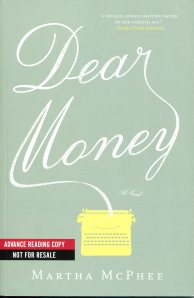
Thank you Houghton Mifflin Harcourt. I love holding the galley in my hand. I love the shape, the size. It’s a beautiful object, a prelude to the book.
I first began thinking about this story on Easter in 2004. I was at my mother’s farm and for various reasons a bond trader for a glittering Wall Street firm (I’m not allowed to reveal the name—but you’d know it) was there (I’m not allowed to reveal his identity either). I chatted him up, curious to understand what it was that he did that caused him to earn so much money. (A reputation preceded him: multiple houses designed by famous, dead, architects, multiple children all in private school. He arrived and departed in a limo, ferrying him to and from New York, idling for him while he enjoyed the Easter festivities, his driver keeping the car warm. My trader oozed bravado and money the way some ooze sex appeal.) He traded mortgage-backed securities, (yes those things that no one had ever heard of and that did but still don’t understand—those things that brought the world economy to a grinding halt) had actually become a manager at this glittering firm high up in the clouds above Manhattan. Traded what? People’s mortgages, pools of them. Pools? He told me all about the MBS market, about the slicing and dicing of vast pools of mortgages—mortgages bundled together to create giant bonds desired by insurance companies, retirement funds, foreign countries even. Mortgages in all sizes and shapes were lumped together to create enormous, astonishing wealth. As he spoke I was fascinated, riveted really. (Remember, this was 2004.) These bankers took our puny mortgage debts (all the yous and all the mes with our unreliable spending habits and our uncertain futures) and amassed it and gambled on it, creating bonds and ultimately a market that at that time was bigger than the entire combined US stock markets, accounting for 8 trillion dollars of debt. (Just 3 years later it would weigh in at 11 trillion.) This was story line on an Olympian scale. This was imagination at work, imagination with consequences—nothing less.
In a cultural that could allow this to happen, where did the artist stand?
Struck by my curiosity and enthusiastic questioning, the fact that I seemed to get what he was speaking about, he propositioned me: “If you give me 18 months I’ll turn you into a star trader.”
“Like Pygmalion,” I said. “You’ll transform me—starving artist to Wall Street tycoon.” It was 2004, those heady days. Guys like this were tired of simply having made loads of money—that was common place as was the mansion that went along with it, the private jets and yachts. They wanted to up the ante, have a little fun and in so doing truly distinguish themselves. I liked the notion: Galatea, Eliza Doolittle. Dear Money is what I did with it.
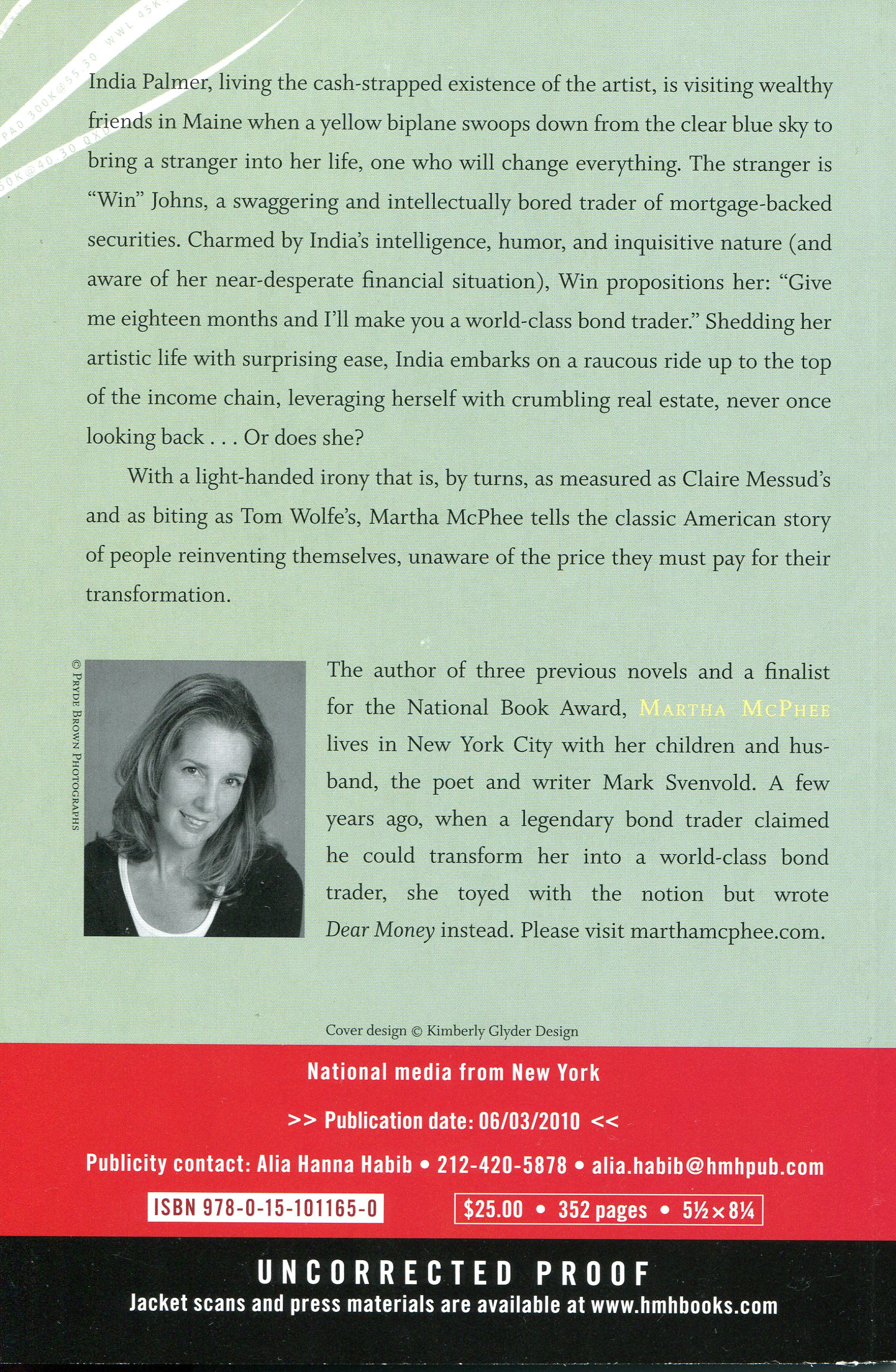
Dear Money is available for pre-order at: Amazon, Borders, and Indie Bound.
















 MARTHA McPHEE