My mother came to visit me today to hang family photographs taken over the years and that had been collecting in a pile in the corner of my dining room. She’s a photographer, you see, as is my sister, Laura, so I have many pictures for the walls, all stunning—pictures they’ve taken and pictures my mother has restored that had belonged to an earlier generation. We focused on black and white today. The pictures included here are all printed on gelatin silver paper in my mother’s studio’s darkroom in Princeton, New Jersey. Since they’ve been archivally treated—washed, fixed, dried—they stand to last a long time. The life span of archival prints is actually not known. Prints still exist, in excellent condition, from the 1870s when the gelatin silver process was first used. Though my mother loves the ease and democracy of digital, in her work her preference is for film and archival prints so that the photos can last.
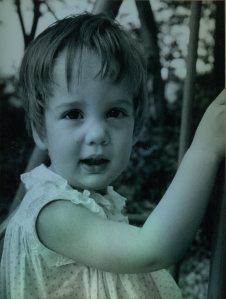
Martha, 1966
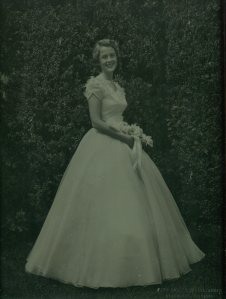
My mother at the May Court Ball at Sweet Briar College, 1956
The dress was made by my grandmother from organdy, the flowers at the shoulders all hand-stitched. Mom’s daughters (I won’t mention which ones) wore the dress to their black tie dances in the 1970s and destroyed the dress from too much dancing.
My maternal grandparents, Charles and Kathryn Brown III just before my parents’ wedding, an evening ceremony, March 16, 1957
Grammy, as I called her, grew up an impoverished cowgirl in Montana. A big reader, she dreamed of marrying a blueblooded Bostonian who’d give her “an extra river water diamond” (a marketing term for superior quality) from Tiffany’s—romantic notions she’d learned about in stories and advertisements in The Saturday Evening Post. She married a Bostonian, as it happened, Charlie Brown, heir to the Buster Brown shoe empire which was essentially defunct by the time she met him. As a child, he was the model for the Buster Brown shoe boy.
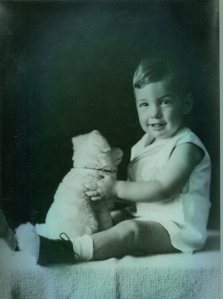
My father with a toy dog, 1932
This is a photograph that my mother had restored. The negative lost, she made a new negative from an original picture and then printed this copy archivally to preserve.
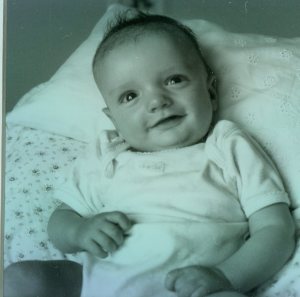
My Jasper, quite new but already smiling, 2004
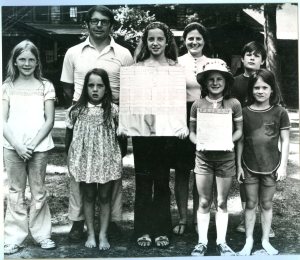
With my father and stepmother and a few of all their children in Percy, New Hampshire, 1973
The wall, where these pictures now hang, tells a story: my parents as children, their marriage, my girlhood, their divorce, my children. The story reaches back, will stretch forward, unfold on other walls—photographs preserving, stopping time.
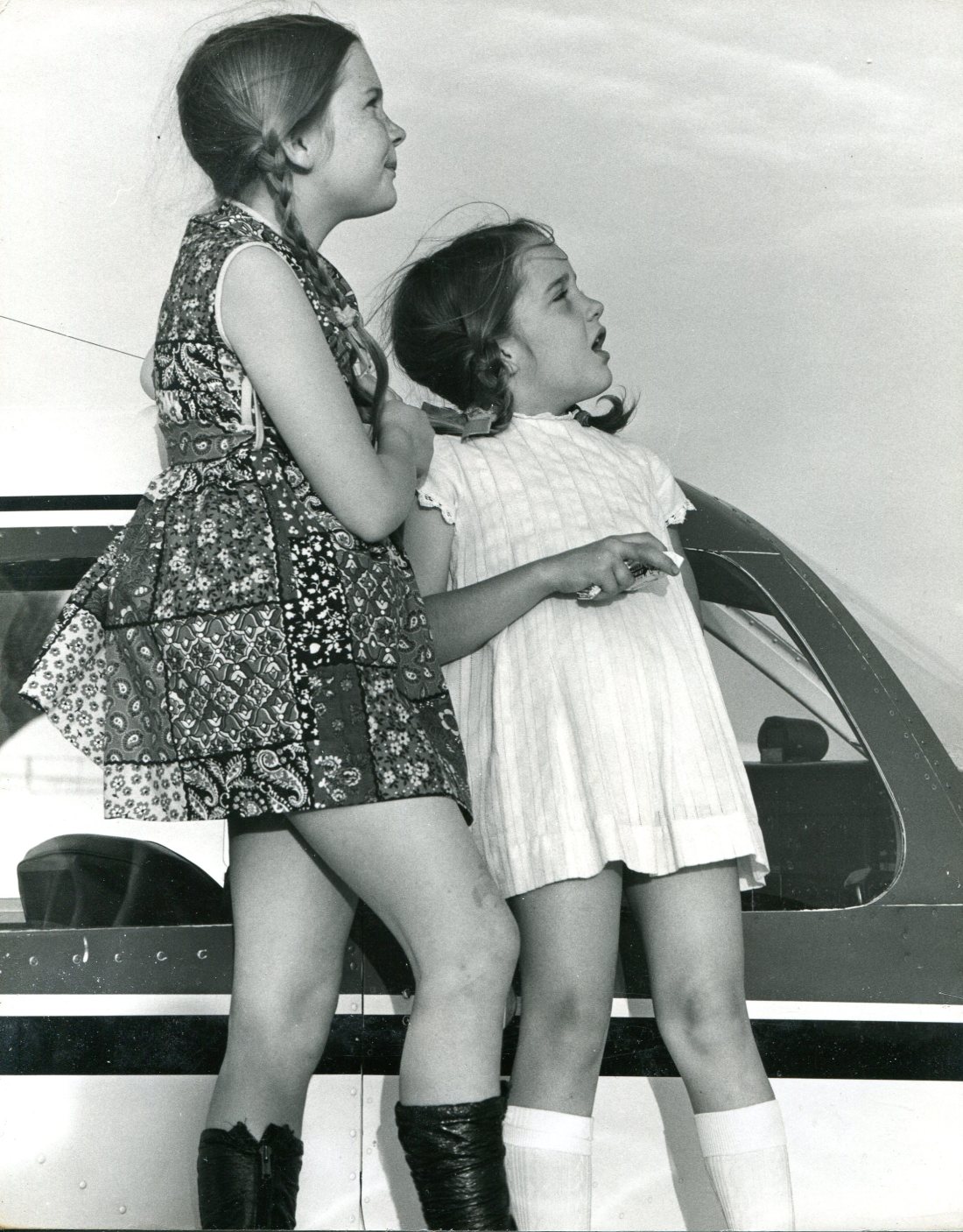
Here, on the wing of my mother’s divorce lawyer’s airplane, Jenny, in patent leather shoe boots (I’m wearing white knee socks, not sexy white patent-leather boots–at six years old, I hadn’t yet learned to compete) already looks like a femme fatale. Jenny has always loved movies. Throughout our childhood she’d stay up late watching the Million Dollar Movies, then the late late movies–illuminated in the blue glow of the television screen, our mother telling her repeatedly that it was time for bed. But Jenny could outlast our mother–tired, she’d give up, falling asleep while Jenny finished watching All About Eve or The Best Years of Our Lives or whatever happened to be playing The Searchers, Stagecoach. Jenny has written three novels and all of them, to some degree, have a noir element. Movies, she knows, she loves.
My students always want to know if it is worth it to spend all that money to get an MFA. Here are some thoughts which I share with them: When I was at Columbia University’s MFA Program in Fiction, the novelist Russell Banks spoke with our class and said that the MFA could be likened to an old-fashioned apprenticeship, one in which for two years the beginning writer is allowed to work at and develop her craft alongside others doing the same thing–like young sculptors in Bernini’s studio in 17th century Rome. It’s also a chance, Banks said, to buy yourself some time.
I have always loved this way of thinking about the MFA. You’re there to develop and grow your own talents, unimpeded by work and life, to explore your craft. This puts the onus on the writer, where it should be, not the program. Of course, the program you choose is important, but it will not make the writer. A writer writes and this is how the writer gets better. The MFA affords you that time while also surrounding you with other aspiring writers in the same position, colleagues you can share your work and concerns with.
Additionally, you study with writers who are devoting their lives to their work and through them you can be opened up to what inspired them and in turn be inspired yourself. And know, you do not need to go into debt to get your MFA. There are many programs around the country that have full or partial scholarships, that offer teaching fellowships. It takes some research and of course a stunning application.
The most important thing to consider is if you’re ready. Are you ready to devote yourself to your work? Is this what you really want? Don’t believe the program will turn you into a writer. That is done by you and you alone. I loved Columbia, but there are any number of fine schools. Here are just a few:
Stanford University’s Stegner Fellowship
(Very difficult to be accepted, perhaps the most competitive and is not an MFA but if you get it, you don’t need an MFA!)
This is just the tip of the iceberg. A comprehensive list of MFA programs can be found at Poets and Writers.
Please don’t hesitate to ask me questions. I think about this subject all the time for my Hofstra students. By the way, as soon as Hofstra establishes its MFA program, of course I’d list it here.
Saturday morning soccer stars. They’ve been playing together since they were five. Today Hannah turns ten. Last season they were undefeated! We love the West Side Soccer League.
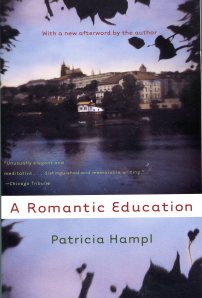
Yesterday the memoirist Patricia Hampl came to Hofstra University as part of the Great Writers Great Readers series, started by Phillip Lopate six years ago. I had never read her work before, but started reading from A Romantic Education and was swept away immediately by the precision and beauty of her detail, of the small speaking to the large.
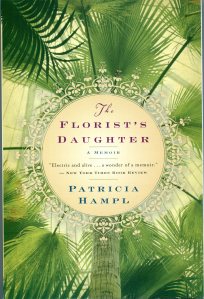
Last night, Hampl read from The Florist’s Daughter, her most recent book. “These apparently ordinary people in our ordinary town, living faultlessly ordinary lives, and believing themselves to be ordinary, why do I persist in thinking–knowing–they weren’t ordinary at all?” Under Hampl’s gaze and through her memory, the lives are made extraordinary. And this makes me think of the ending of Middlemarch–
…[For] the growing good of the world is partly dependent on unhistoric acts; and that things are not so ill with you and me as they might have been, is half owing to the number who have lived faithfully a hidden life, and rest in unvisited tombs.
I begin here, with what makes me smile today: my cousin Charles McPhee.
Charles McPhee, the Dream Doctor, who until 2006 had a syndicated radio program called The Dream Doctor Show. A Princeton graduate, he has devoted his life to amassing the largest dream database on earth, over 600,000 dreams, because he believes that dreams are windows into the soul and he wants to help unlock their meanings for those who are baffled and confused and care to understand. (You can find out more about Charles and his dreams www.dreamdoctor.com.)
Charles is my handsome, dashing, Adonis-like cousin on whom I had an enormous crush as a young girl—in fact, I still do. A freshman at Princeton, Charles and a friend of his, Russ Morrow (also handsome and dashing) took my best friend, Kate, and me to our high school’s junior prom because we didn’t have dates. Some cousin! If we didn’t think about how embarrassing it was to have a cousin and his friend take us to our prom, it was grand: Charles and Russ the most sophisticated, fun, and best-looking boys in the room.
In June of 2006 Charles was diagnosed with an aggressive form of ALS—Amyotrophic lateral sclerosis (ALS), often referred to as “Lou Gehrig’s Disease,” a progressive neurodegenerative disease that affects nerve cells in the brain and the spinal cord. As the disease advances patients become increasingly paralyzed. (For more information see www.alsa.org and read a wonderful essay Charles wrote for the Princeton Alumni Magazine.)
The other day, after a long stretch of not hearing from Charles, knowing that he was now in a wheel chair and had lost the mobility of his hands, I received an email from him which contained a song, Wicked Hangover from Timmy.
Wicked Hangover from Timmy
I loved that he had made this, loved the song, and asked for another:
My Dad
I was astonished and told him so, asked questions. How was he accomplishing this, when, with whom? You need to understand that his voice was the first thing he lost. Fans called into his radio show, complaining to him, worried about him because he was slurring his words and they thought he was drunk on the air. This led him to the doctor. Now he can’t speak.
In response to my questions, he wrote:
“it really is one of the most fun things ive ever done. the songs are all recorded on a four track tape recorder (fancy) by my very good friend rod barr , with whom I used to write and play music when we were at princeton together the trick is that he’s never heard these songs . I wrote them after pu. so I write out the lyrics and chords , and then we go through this process of adjusting rhythm tempo, feel tone phrasing attitude emphasis etc. fortunately rod is the most gifted musician i know and our communication is excellent and vaguely telepathic after so many years of friendship that it all goes quickly. funny, when facing death, this was one of the most important things for me , that the art be realized, and not be lost for ever. so I am having double fun with it , because of the ridiculous circumstances , and because it reunites me and rod, doing what we always loved doing together .and because we are getting the art out.
xx your psychedelic cuz”
How, physically do you get it out? I ask. He responds:
i write with a reflective dot on my forehead read by a camera that moves a cursor and when I hold it steady it selects a letter on a keyboard on the computer screen. it is ingenuous. some of my best country redneck ya yas
The Rain Song
Talking with his sister Larkin, she paraphrased Victor Frankl who wrote that real suffering isn’t physical suffering, real suffering is when you have no meaning in life. These songs are pouring from my cousin Charles, filled with meaning and purpose, deliberate and determined. He is my hero.
The Rain Song
(lyrics and chords written by Charles with his reflective dot)
G F C
when I look out on this dry August road
I see the heat comin down in waves
and there’s one thing I got to know
when the man come an take it away
when will the rain come
when will it fall
when will it bust these walls
and lift us up
you’re ma favorite girl
and you know i’ve always loved you true
but now there’s another girl
and I want her too
here I am I’ve put up half of my life
and I’ve bet to lose
just for the chance to ride a palamino mare
I don’t understand it either
Em F
well I’ve tried and I’ve tried
Em F C
but I still can’t find why
Em F D
why I do these things that I do
well I’ve cried and I’ve cried (same chords )
cause I see what I’m doing
girl I’m breaking us both in two
After first chorus , want to try 4 measures of
g to F, then key shift to A G D for 2 measures , then repeat chorus in Em F C, etc . Lead will be above key changes.
for forty days and for forty nights
the war was waged in my heart
and I come out feeling like a broke down Ford
wid somebody kicked in the lights
well Lord knows I ain’t no A student
and I ain’t too fine with the words
I’m just a man with a restless heart
searching for his own world
ya know the morning sun is calling me on
and like a fish to the water I’m drawn
I got to keep on keeping on
it’s the only way I know
so baby sing it
c’mon and sing it
sing it with me
(a capella with multi-cowboy boot foot stomp on wooden plank)














 MARTHA McPHEE