
[clearspring_widget title=”Animoto.com” wid=”46928cc51133af17″ pid=”4b6a21503afcb69f” width=”432″ height=”240″ domain=”widgets.clearspring.com”]


[clearspring_widget title=”Animoto.com” wid=”46928cc51133af17″ pid=”4b6a21503afcb69f” width=”432″ height=”240″ domain=”widgets.clearspring.com”]

THE BOOK TOUR. We’ve all heard about them: the author reading for an audience of three, two, one, none. You fly across the country to San Francisco, feeling important. You are chauffeured to the bookstore, attended by a literary escort. Signs all over the store announce your event at 7 P.M. A voice comes over the intercom: You’ll find India Palmer in the children’s section. She’ll be reading from her new book, Generation of Fire, and signing copies. Five minutes till show time. There, squeezed into the children’s section, between rows of Mazy and Olivia and Lilo and Stitch and Goodnight Moon, are a couple of dozen chairs in front of which stands a microphone and a table with your books neatly stacked, several standing prominently on display.
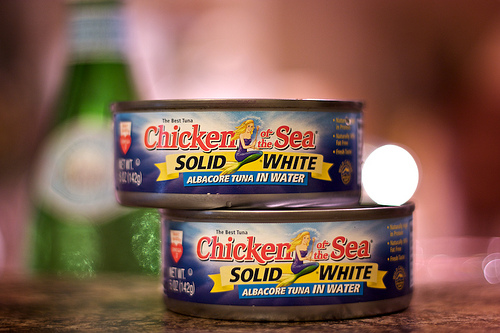
In the back row sits one old lady. It took six years to write Generation of Fire! Oh well, you think gamely, the show must go on. You notice the old lady is unwrapping something from a paper bag. She takes out a small tin and rests it in her gnarled, arthritic hand, and with her other hand she pries off the lid. Her hair is long and white and unbrushed. The can she has opened, you realize, though she is a good many rows removed from you, is tuna fish. The oily smell wafts toward you. She proceeds to eat it with a plastic fork pulled from the folds of her dress.
Onward! You read for her. With all the emotion you can muster. There is someone else in the audience: a young girl, who arrives late. When you’re finished, she raises her hand earnestly. “Yes?” you ask. Her eyes are bright and her skin is aglow with teenage youth. She has an athletic build and an innocence that makes you ache for her. “I have an assignment I need to do for my English class,” she says. “I’m supposed to interview an author. Can I interview you?”
From Chapter Nine of Dear Money

Bright Angel Time, my first novel had so many terrible working titles, but I wrote the book so long ago I can’t remember what they were. I do remember that my editor wanted to change the title from Bright Angel Time to Falling Backwards. I refused because a Michael Douglas film was recently out called Falling Down and I didn’t like the association. And, also, I loved my title. I found it while hiking in the Grand Canyon with my husband a few months before finishing the book. He had taken me there for inspiration. We were camped beneath the stars near the Bright Angel Trail and I can remember still the cool, desert air, being tucked in my bed roll, dreaming quite literally that I was the daughter of Clint Eastwood—the Eastwood of the spaghetti westerns that I love so much. I remember waking up disappointed that the dream wasn’t true. (Forgive me, Dad.) Hiking out of the Grand Canyon, I knew even then, long before giving birth, that it would be the hardest thing I would ever ask my body to do—harder than childbirth. (I thought of that when my first child was born. And, by the way, I was right.) As I hiked out, like a flash it came to me: Bright Angel Time would be the title of my novel. Bright Angel is the name of a shale in the canyon that represents a period of time some 500 million years old from the Cambrian period in the Paleozoic. Bright Angel shale, as a layer of the canyon’s strata, lies between Muav limestone and Tapeats sandstone. Metaphors about time started bombarding me. And I loved all the names.

Gorgeous Lies, my second novel. I had many bad working titles. To name two: Quo Vadis (I cringe to write that) and Farther India (which comes from an old map of Hindoostan.) My editor thought that Farther India sounded either like Father India or a travel guide. I agreed. I despaired as I had no other ideas. My mother suggested that I read some of my husband’s poems, promised me I’d find a title there.
From the last stanza of “Memo: From The Course of Empire By Bernard DeVoto”
How do I love thee, and why? O, congeries
of gorgeous lies, I’ve lost my way,
and rivers flow into other rivers, and they
flow into rivers that flow into the sea
From Empire Burlesque by Mark Svenvold
L’America, my third novel. I was also asked by my publisher to consider something else but couldn’t think of anything I liked as well. I was in love with an Italian man once and he used to say “l’America” quite a lot, with a sense of humor and impossibility—as though only in America. A beautiful admiration and absurdity.

And finally, Dear Money, my fourth novel. At first, and for most of the writing of the book, it was called I Can’t Keep Up: The Truth About The Joneses. I jettisoned The Truth About The Joneses, and then toward the end jettisoned I Can’t Keep Up-–because, I discovered, the main character keeps up and boy does she. She transforms herself from struggling novelist to MBS trader. I thought very briefly about using Our Times, a shortened version of “a sign of our times” or “our foolish times.” But it seemed t0o much like Hard Times or In Our Time. Then I read the brilliant biography of Maxwell Perkins: Editor of Genius by Scott Berg and found in there a letter to Perkins from Fitzgerald. Here, the last paragraph of that letter:
“I think Tom Boyd’s book is excellent—the preface is faintly pretentious but the stories themselves are great. By the way I think my new collection will be called Dear Money. It ought to be awfully good and there will be no junk in it.
Yours in a Tremble,
Scott”
Fitzgerald jettisoned Dear Money for his collection of stories, calling it instead All The Sad Young Men. In my family, filled with writers, when we hear something we like we jut our hand into the air and say, “That’s mine.” It means no one else can use it. That’s mine, I said to myself. That’s it. That’s the title of my fourth novel. As a book that is quite interested in the subject of money, who better to offer me its title than Fitzgerald?
A tip: working titles, as bad as they may be, help you in ways you might not understand through the first drafts. Don’t be embarrassed by them, but know they are rarely, in my experience, the final title. Use them for what they offer and then laugh about them later.
Another tip: If in your heart you love your title and your publisher asks you to change it, DON’T—unless, of course, a convincing argument is made that you believe in, in your most artistic heart. My husband let go of the title he desired most for his first book on nonfiction. His title was A Century’s Corpse. A great title. It comes from a Thomas Hardy poem. Mark’s book was about a corpse that traveled from freak show to freak show across the 20th Century. His title was perfect but the publisher thought people would be turned off by the word corpse so used the corpse’s name instead: Elmer McCurdy. Mark regrets giving in to this day.
Special thanks to F. Scott Fitzgerald for discarding his working title.
Where do your titles come from? Please let me know.


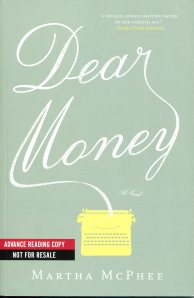
Thank you Houghton Mifflin Harcourt. I love holding the galley in my hand. I love the shape, the size. It’s a beautiful object, a prelude to the book.
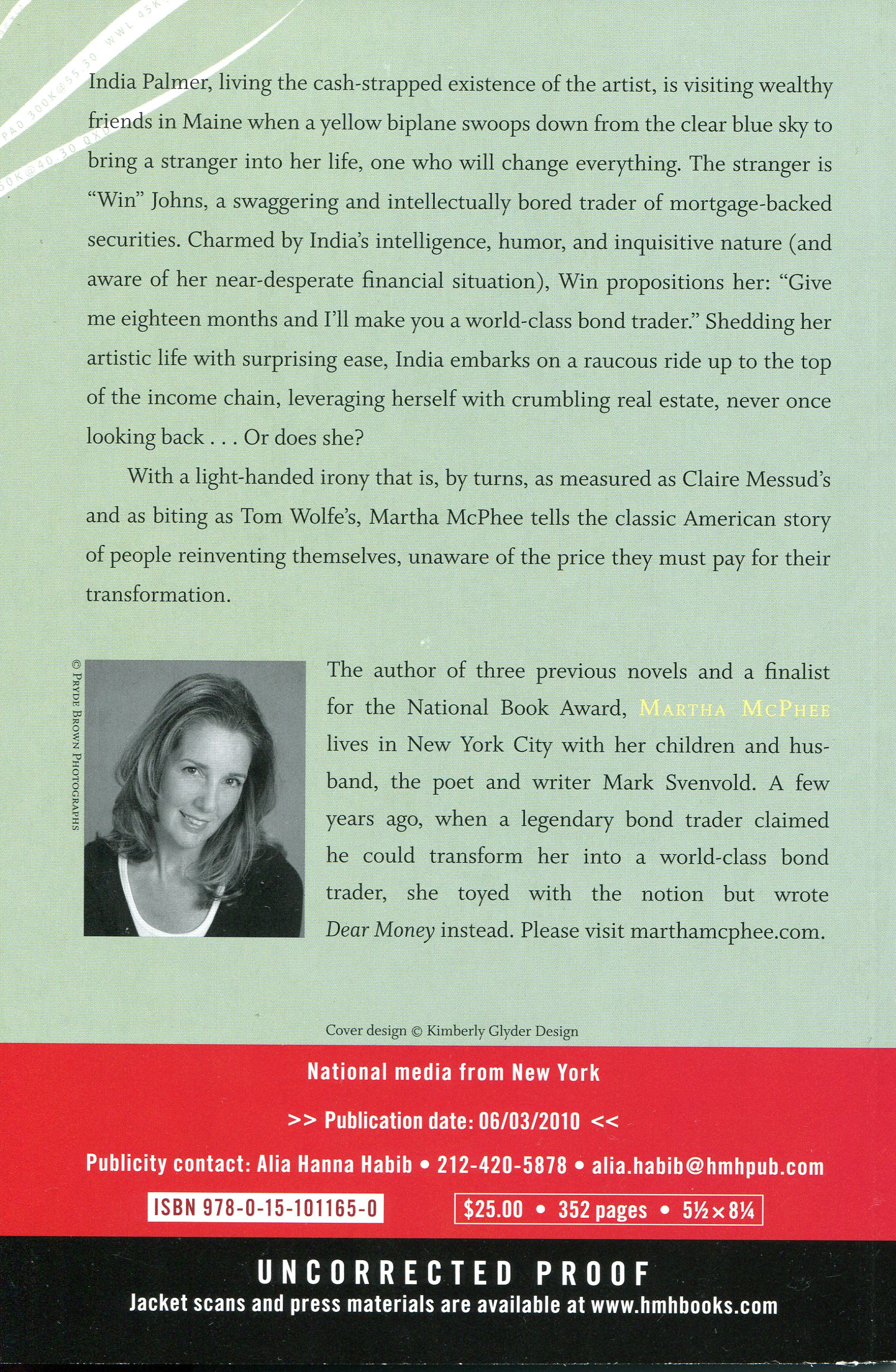
I first began thinking about this story on Easter in 2004. I was at my mother’s farm and for various reasons a bond trader for a glittering Wall Street firm (I’m not allowed to reveal the name—but you’d know it) was there (I’m not allowed to reveal his identity either). I chatted him up, curious to understand what it was that he did that caused him to earn so much money. (A reputation preceded him: multiple houses designed by famous, dead, architects, multiple children all in private school. He arrived and departed in a limo, ferrying him to and from New York, idling for him while he enjoyed the Easter festivities, his driver keeping the car warm. My trader oozed bravado and money the way some ooze sex appeal.) He traded mortgage-backed securities, (yes those things that no one had ever heard of and that did but still don’t understand—those things that brought the world economy to a grinding halt) had actually become a manager at this glittering firm high up in the clouds above Manhattan. Traded what? People’s mortgages, pools of them. Pools? He told me all about the MBS market, about the slicing and dicing of vast pools of mortgages—mortgages bundled together to create giant bonds desired by insurance companies, retirement funds, foreign countries even. Mortgages in all sizes and shapes were lumped together to create enormous, astonishing wealth. As he spoke I was fascinated, riveted really. (Remember, this was 2004.) These bankers took our puny mortgage debts (all the yous and all the mes with our unreliable spending habits and our uncertain futures) and amassed it and gambled on it, creating bonds and ultimately a market that at that time was bigger than the entire combined US stock markets, accounting for 8 trillion dollars of debt. (Just 3 years later it would weigh in at 11 trillion.) This was story line on an Olympian scale. This was imagination at work, imagination with consequences—nothing less.
In a cultural that could allow this to happen, where did the artist stand?
Struck by my curiosity and enthusiastic questioning, the fact that I seemed to get what he was speaking about, he propositioned me: “If you give me 18 months I’ll turn you into a star trader.”
“Like Pygmalion,” I said. “You’ll transform me—starving artist to Wall Street tycoon.” It was 2004, those heady days. Guys like this were tired of simply having made loads of money—that was common place as was the mansion that went along with it, the private jets and yachts. They wanted to up the ante, have a little fun and in so doing truly distinguish themselves. I liked the notion: Galatea, Eliza Doolittle. Dear Money is what I did with it.
Dear Money is available for pre-order at: Amazon, Borders, and Indie Bound.


 MARTHA McPHEE