Run, Daddy, Run

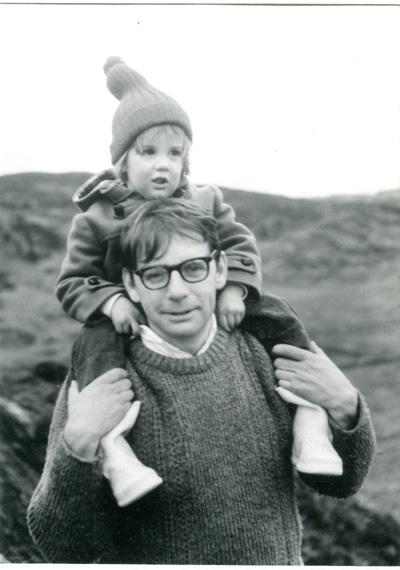
I’ve been traveling since I was a toddler.  My mother and father and sisters and I took an ocean liner from New York City to England because my parents were afraid to fly.  Young as I was I still remember little things.  I remember that two of my sisters got sea sick out in the middle of the Atlantic, the great boat bobbing about and my sisters throwing up into bags tied to the bed posts.  My sisters were green.  On the deck we wrapped in blankets and listened to the ocean.  It was April and cold.  In London we had tea at Brown’s, tiny, crustless sandwiches presented on a tiered, silver tray.  And after I recall believing that my mother was going to drive the taxi because she got in that side of the car.  Somewhere we picked up the red VW bus and drove it to Spain, then to France, then to Scotland, to the Island of Colonsay where the McPhees come from, farmers originally — the island’s poorer folk.  We lived there for six months while my father did research and wrote The Crofter and the Laird and my sisters went to a one-room school house and made little Scottish friends.  I remember sitting on my father’s shoulders and tapping him with my heels as if he were a horse and saying, “Run, Daddy, run.”  And he would run, at the edge of the sea, across the moors, thrilled by my delight and adventure and curiosity, and I’d kick him just a little bit more if he dared to slow down.  “Run, Daddy, run.”  I was traveling.  I remember nothing more of the trip, but have been traveling ever since.
619H7W4PekL._AA160_

Out of the blue, as I was writing the above, my father emailed me the following — brief notations, a scribbled itinerary:

1967, April through September.  Six months in Europe with entire
family, researching “The Crofter and the Laird”, “Pieces of the Frame”,
“Josie’s Well”, “From Birnam Wood to Dunsinane”, “Twynam of Wimbledon”, and
“Templex” (these pieces were written over the next couple of years).  To
Bath, April 25.  To Colonsay, May 1. May 6, climb Kilchattan hills (“Run,
Daddy, run.”)  May 11, Balaromin Mor. May 23, Donald Garvard.  May 24,
Oronsay — Andrew Oronsay.  May 25, the Ardskenish Peninsula.  June 4, Martha
baptized in the Church of Scotland.  June 6, leave island.  June 12, Loch
Ness Phenomenon Investigation Bureau.  June 13, Dame Flora McLeod of McLeod,
Station Hotel, Inverness.  June 14, Captain Smith Grant, Glenlivet.  Then
George C. Harbinson, Macallan, Cragellachie.  June 15, Donald and Jean
Sinclair, Dunsinnan.  Later Sir Ian Moncreiff of that Ilk, Easter Moncreiff.
June 19-26, London, Wimbledon, Robert Twynam.  June 27, France.  July 4, by
ship from Valencia to Mallorca.  July 25, leave Mallorca.  August 1-4,
Madrid.  August 5, La Granja, Segovia, camped Avila.  August 6, camped
Salamanca.  August 9 to September 7, Suances.  August 20, arrive New York.

My three-year-old’s memory was a little off – – Colonsay first, etc.  So much for memory generally.  Memory is fiction.  My father, 36 at the time, makes a mistake even with the final dates.  Details aside, of their daughters our parents made travelers.
Time, Time, Time: The Clock

74733

I’m on a mission to enjoy my city more – – to find time to indulge in fragments of its bounty and beauty and whimsy and whatever else.  This morning before Jasper’s futsal and Livia’s tennis, before their piano and homework and the dismantling of the Christmas tree, we rose early and snuck off to MOMA to see an hour or so of Christian Marclay’s The Clock.  We arrived just before ten and left at a quarter after eleven – – all four of us riveted by the urgency of time, trying to place the actor, recognize the clip … conscious, conscious.  It’s gimmicky yes, at first, until the larger desperation of us collectively takes over.  I also kept appreciating how the piece is an ode to structure – – how a solid, compelling structure can allow you to accomplish just about anything.  Sort of like the freedom the poet finds in form.  Jasper, 8, Livia, 12, want to return in the middle of the night.  So do I.  We may attempt this Friday at the next round the clock viewing.

At The Dam With Joan Didion

(One Pleasure A Day : Co-posted with Année Kim)

For pleasure and thought, Année sent me Joan Didion‘s At The Dam, a brief essay written in 1970.  Année emailed it to me in the middle of the night, both of us sleepless and ready to enjoy perfect sentences and notions of our impermanence and vulnerability.  Année wrote: If the Himalayas are doomed then Hoover Dam certainly doesn’t stand a chance, but I guess men can’t resist playing God.   

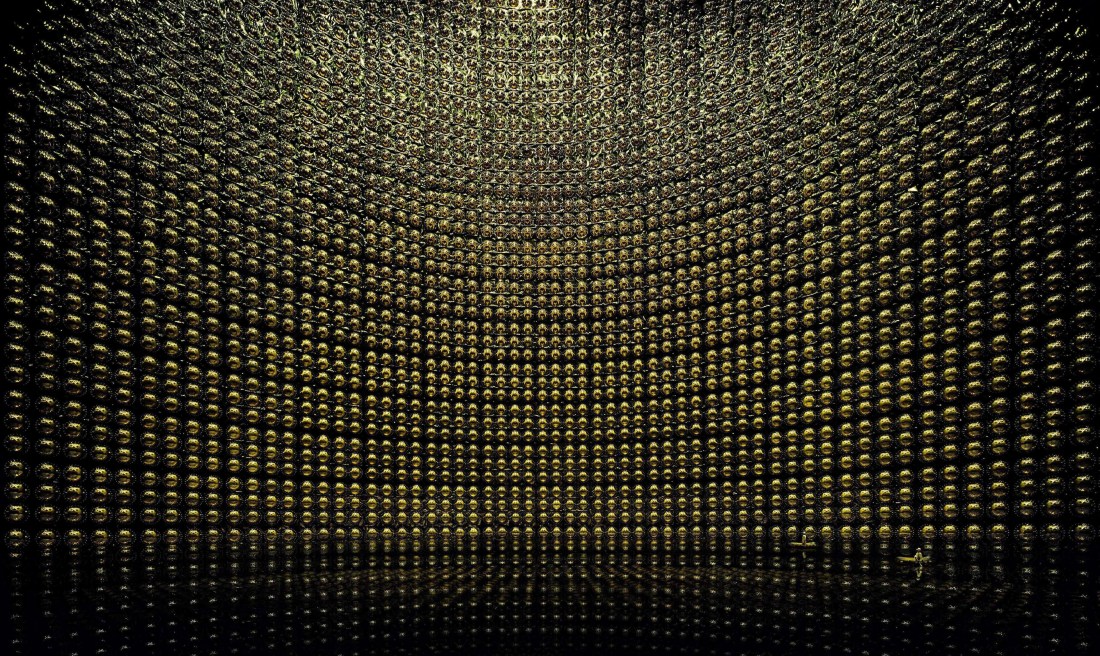
In the essay, Didion speaks of the image of the Hoover Dam staying with her.  This made us think of images by Andreas Gursky and how they seem to capture her words, especially his photo of the Super-Kamiokande neutrino observatory un Mount Kamioka in Japan.

gursky-kamiokande-md

At The Dam comes from Joan Didion’s The White Album: images

I Just Received Jerusalem

Jerusalem-A-Cookbook-by-Yotam-Ottolenghi-and-Sami-Tamimi

My sisters have been discussing this.  One of the dishes Laura made for Thanksgiving was Roasted Cauliflower and Hazelnut Salad.  (It’s pictured in this rave NYTimes blog post.)  Sarah has called me four times since a dinner party she had on December 29 to tell me how divine the Roasted Chicken with Clementines and Arak is.  I’m looking forward to all the meatballs (there are six recipes for them) and to stuffing eggplant with lamb and pine nuts and to traveling to Jerusalem through Ottolenghi’s food and stories.  I feel a dinner party of my own coming on …

Keep Civil War Recipes — Keep

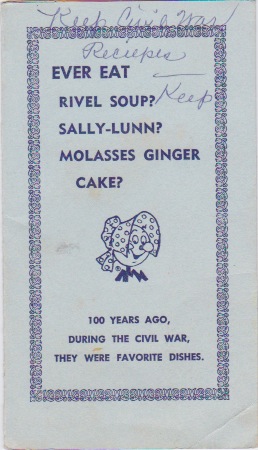
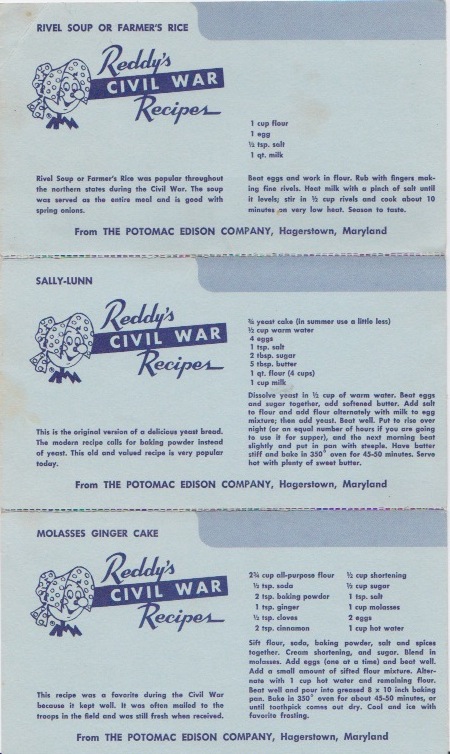
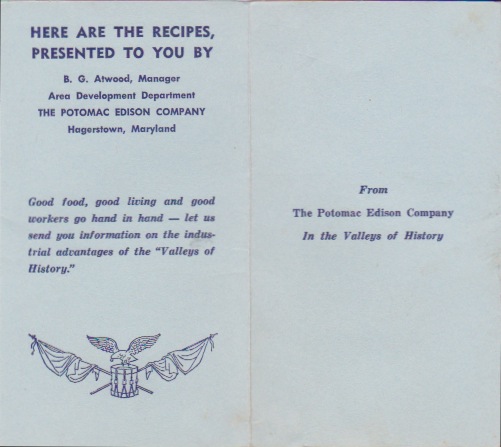
In my grandmother’s emphatic scrawl she instructs that these recipes, part of some sort of public relations campaign for the Potomac Edison Company of Hagerstown, Maryland, be kept, saved.  My grandmother added this to her collection over fifty years ago and, forward thinking, left a message — like one in a bottle — to those of us downstream.  The pamphlet of recipes is on my desk now, downstream.  She’s been dead seventeen years and her box of jumbled recipes, never ordered by her (or yet by me) also sits on my desk.  And from time to time I reach into it and pluck randomly to see what I will find and where I will be taken.  Her box is an archive of time, an archeological dig on a miniature scale, perched right here, holding the dreams and education and reality, not to mention culinary habits, of a 20th century woman’s life.  This little pamphlet was folded into her collection 100 years after the Civil War and she wants those whose hands it will fall into later to keep it.  “Keep” she instructs twice, almost desperately.  Keep.  She doesn’t want history to be swallowed whole and forgotten.  Who knows if Rivel Soup and Sally Lunn and Molasses Ginger Cake (which, the pamphlet tells us, was a favorite because it kept well and could be mailed to the troops in the field and still remain fresh) were actually favorites.  But does it matter?  The message in this pamphlet is that “good food, good living and good workers go hand in hand” and it promises the “industrial advantages of the ‘Valleys of History.'”  My grandmother rises from this box of hers on my desk with her offering: recipes, wars, my life, your life, our lives, history — don’t forget.  Keep.